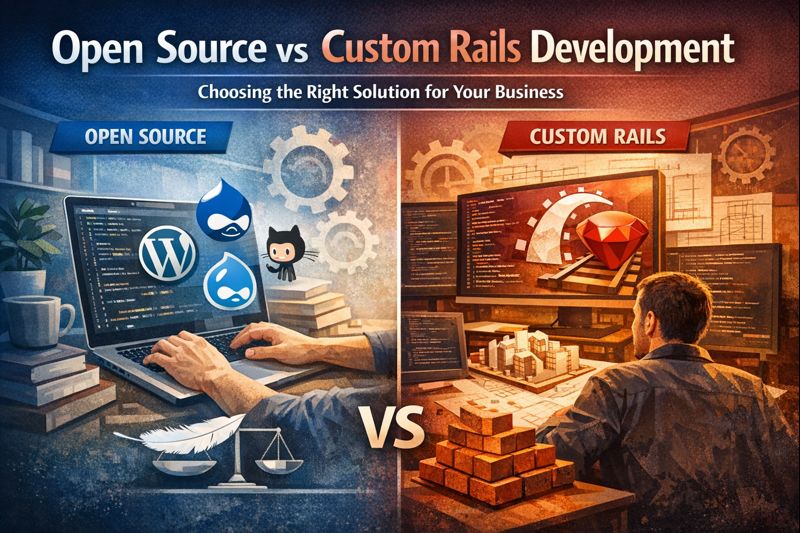
This article explores when it makes sense to rely on existing open‑source software and when investing in a custom Ruby on Rails solution is the better long‑term choice. We’ll also address a common concern: while custom software may seem heavier and more expensive upfront, it often results in a system that truly fits the company’s needs and strategy.
This article explores when it makes sense to rely on existing open‑source software and when investing in a custom Ruby on Rails solution is the better long‑term choice. We’ll also address a common concern: while custom software may seem heavier and more expensive upfront, it often results in a system that truly fits the company’s needs and strategy.
What Do We Mean by “Open Source” and “Custom Software”?
Before diving into trade‑offs, let’s clarify the terms.
Open‑Source Software
Open‑source solutions are existing products or frameworks whose source code is publicly available. Examples include CMS platforms, e‑commerce engines, CRMs, analytics tools, or internal admin systems. You typically:
- Install or deploy the software
- Configure it to your needs
- Extend it via plugins or minor customizations
Custom Software (Ruby on Rails)
Custom software is built specifically for your organization, from the ground up or on top of a framework like Ruby on Rails. The system’s architecture, features, and workflows are designed to match your business processes exactly.
Rails is particularly well‑suited for this approach due to its convention‑over‑configuration philosophy, mature ecosystem, and strong productivity benefits.
When Open‑Source Software Is the Better Choice
Open‑source solutions can be incredibly powerful when used in the right context. They shine when your needs closely align with what already exists.
1. Your Requirements Are Standardized
If your business processes are common and well understood, an existing solution is often sufficient. Examples include:
- Content management
- Blogging platforms
- Basic e‑commerce
- Ticketing or helpdesk systems
In these cases, building custom software would likely duplicate what already works well.
2. Speed to Market Is Critical
Open‑source software allows you to:
- Launch quickly
- Validate an idea
- Start generating value almost immediately
Configuration is almost always faster than development from scratch.
3. Budget Is Limited
For early‑stage startups or internal tools with limited strategic importance, open source significantly reduces upfront costs. You avoid:
- Initial development expenses
- Long discovery and design phases
Instead, you invest primarily in setup, hosting, and light customization.
4. You Can Accept Constraints
Using an existing solution means accepting its:
- Data model
- Feature set
- Architectural decisions
If your team can comfortably work within those boundaries, open source is a pragmatic choice.
The Hidden Costs of Open Source
While open source may look cheaper and simpler at first, it’s important to understand the long‑term implications.
- Customization limits: Deep changes can be difficult or risky
- Upgrade pain: Custom patches often break during updates
- Unused complexity: You ship and maintain features you’ll never use
- Vendor or community dependency: Project direction may change—or stop entirely
At a certain point, teams realize they are bending their processes to fit the software, rather than the other way around.
When Custom Ruby on Rails Software Makes Sense
Custom development is not always the obvious choice—but when it is, it can become a serious competitive advantage.
1. Your Business Logic Is Unique
If your company differentiates itself through:
- Non‑standard workflows
- Complex rules or pricing models
- Domain‑specific processes
…then forcing these ideas into an off‑the‑shelf product often creates friction and technical debt. Custom Rails software allows you to model your domain accurately and clearly.
2. Software Is Core to Your Business
When the application is the business (or directly enables it), flexibility and control matter more than short‑term savings.
Custom software allows you to:
- Evolve features alongside strategy
- Experiment quickly
- Remove or add functionality without constraints
3. You Need Long‑Term Scalability (Not Just Traffic)
Scalability isn’t only about handling more users—it’s also about:
- Supporting new use cases
- Adapting to organizational changes
- Integrating with internal and external systems
Rails applications, when designed well, scale very effectively in all of these dimensions.
4. You Want Ownership and Control
With custom software:
- You own the codebase
- You control upgrade paths
- You decide architectural trade‑offs
This independence is especially valuable for companies with long product lifecycles or strict compliance requirements.
Addressing the Elephant in the Room: Cost and Complexity
Yes—custom software is usually:
- More expensive upfront
- Heavier in terms of initial effort
- Slower to launch than installing an existing solution
However, this investment often pays off over time.
Why Custom Software Can Be Cheaper Long‑Term
- No workarounds or hacks
- Less fighting against the system
- Cleaner code aligned with real use cases
- Easier onboarding for developers who see business logic clearly expressed
Instead of accumulating complexity through plugins and overrides, you start with exactly what you need—and nothing more.
Why Ruby on Rails Is a Strong Choice for Custom Development
Ruby on Rails strikes a balance between speed and robustness:
- Rapid development thanks to conventions and generators
- Readable code that reflects business intent
- Mature ecosystem of well‑tested gems
- Proven track record across startups and enterprises
Rails makes custom software less risky and more predictable than many teams expect.
A Practical Decision Framework
Ask yourself the following questions:
- Are our processes standard or unique?
- Is this software a temporary solution or a long‑term asset?
- Are we adapting our business to the tool—or the tool to our business?
- Will our requirements change significantly in the next 2–3 years?
If most answers point toward flexibility, differentiation, and long‑term value, custom Rails development is likely the right choice.